
AI-DLC Core Framework
This section outlines the core framework of the AI-DLC, detailing its phases, roles, workflows, and key artifacts.
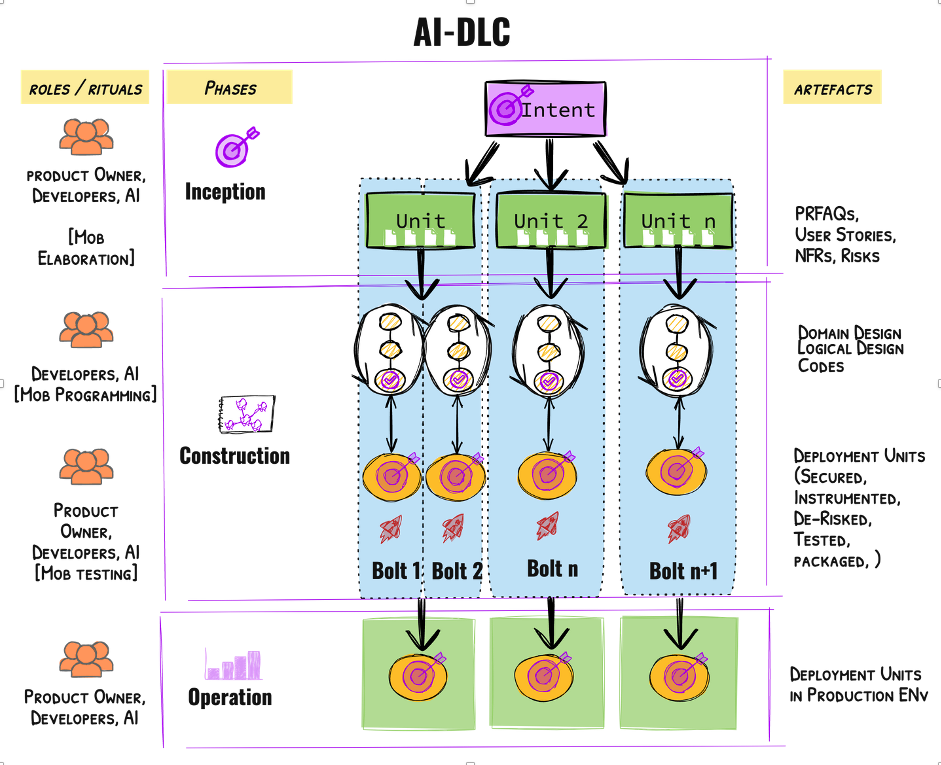

An Intent in AI-DLC is a high-level statement of purpose that encapsulates what needs to be achieved, whether a business goal, a feature, or a technical outcome. It serves as the starting point for AI-driven decomposition into actionable tasks, aligning human objectives with AI-generated plans.

A Unit represents a cohesive, self-contained work element derived from an Intent, specifically designed to deliver measurable value. For instance, an Intent to implement a business idea may be decomposed into Units representing independent functional blocks, analogous to Subdomains in DDD or Epics in Scrum.

A Bolt is the smallest iteration in AI-DLC, designed for the rapid implementation of a Unit or a set of tasks within a Unit. Bolts (analogous to Sprints in Scrum) emphasize intense focus and high-velocity delivery, with build-validation cycles measured in hours or days rather than weeks. Each Bolt encapsulates a well-defined scope of work (e.g., a collection of user stories within a Unit), enabling incremental progress while maintaining alignment with the overall objectives of the Intent.

The Domain Design artefact captures the core business logic of a Unit, independently of technical components. In the first version of AI-DLC, AI uses domain-driven design principles to create the strategic and tactical modelling elements including aggregates, value objects, entities, domain events, repositories and factories.

Deployment Units are the operational artifacts encompassing the packaged executable code (ex. container images for Kubernetes environments, serverless functions), configuration (ex. Helm Charts), and infrastructure components (ex. Terraform or CFN stacks) that are tested for functional acceptance, security, NFRs, and other roles.

The Inception Phase focuses on capturing Intents and translating them into Units for development. To achieve this we use "Mob Elaboration", a collaborative requirements elaboration, where all roles (Product Owner, Developers, AI) participate in initial breakdown of the Intent into Units. The Product Owner and Developers collaboratively review and refine these suggestions. The outputs of this phase include well-defined Units and their respective components, including a Unit Definition, a Non-Functional Requirement (NFR) definition, a Description of Risks (including with mitigations that Register, if present), a Measurement Criteria that takes to the business Intent and the IT Suggested Bolts using which the Units can be constructed.

The Construction Phase encompasses the iterative execution of tasks, transforming the Units defined during the Inception Phase into tested, operations-ready Deployment Units. The process is structured through Domain Design, where non-functional requirements and appropriate cloud service patterns are applied. Then AI generates detailed code from Logical Designs while adhering to well-architected principles. The phase concludes with automated testing to ensure functionality, security, and operational readiness. Developers focus on validating AI-generated outputs at each step and making necessary refinements to ensure quality and alignment with business objectives.

The Operations Phase in AI-DLC centers on the deployment, observability, and maintenance of systems, leveraging AI for operational efficiency. AI actively analyzes telemetry data, including metrics, logs, and traces, to detect patterns, identify anomalies, and predict potential SLA violations, enabling proactive issue resolution. Additionally, AI integrates with predefined incident runbooks, proposing actionable recommendations such as resource scaling, performance tuning, or fault isolation and execute the resolutions when approved by the Developers. Developers serve as validators, ensuring AI-generated insights and proposed actions align with SLA and compliance requirements.
The AI-DLC methodology integrates AI assistance across all phases of the software development lifecycle:
| Phase | AI Assistance | Key Capabilities |
|---|---|---|
| 1. Requirements & Planning | Requirement clarification and project planning | AI-assisted requirement clarification, automated user story generation, intelligent project estimation, risk assessment and mitigation planning |
| 2. Design & Architecture | Architecture and design optimization | Architecture pattern recommendations, API contract drafting, database schema optimization, component relationship mapping |
| 3. Implementation | Code generation and review | Context-aware code completion, real-time code reviews, automated refactoring suggestions, integration pattern implementation |
| 4. Testing & Quality | Automated testing and quality assurance | Automated test case generation, regression test analysis, performance testing optimization, security vulnerability scanning |
| 5. Deployment & Operations | Infrastructure and operations automation | Infrastructure-as-code templates, CI/CD pipeline optimization, monitoring and alerting setup, performance tuning recommendations |